
Window Packaging Films -BOPP, OPS or PET : Which Is Right for Your Envelope Converting Line?
Choosing a window film for envelope converting is not a straightforward decision. Three materials dominate the market — oriented polystyrene (OPS), biaxially oriented polypropylene (BOPP) and polyethylene terephthalate (PET) — and each comes with a different profile of rigidity, optical performance, machinability, density and end-of-life compatibility. What worked five years ago may not be the right specification for 2026.
Before comparing materials, four requirements define the specification for any envelope window film : rigidity for clean die-cutting, controlled haze for postal sorting readability, dimensional stability under hot-melt bonding temperatures, and COF calibrated for high-speed insertion equipment. These requirements — not material identity — should drive the decision.
OPS: The Incumbent With a Sustainability Problem
OPS has dominated envelope window converting for decades because it delivers rigidity, consistent haze and reliable machinability on hot-melt bonding lines. Most converting equipment was calibrated around it.
The problem is not performance — it is end-of-life. OPS is not compatible with PP recycling streams and creates contamination in paper envelope recycling. As postal operators and corporate mailers across Europe face increasing pressure to demonstrate sustainable procurement, OPS is becoming a specification liability. The EU PPWR is accelerating this pressure — and qualification cycles for window film alternatives run six to twelve months.
PET: High Performance, High Cost, Recyclability Questions
PET window films offer maximum optical clarity and excellent dimensional stability — technically well suited to high-specification postal formats. The limitations are cost and recyclability. PET carries a significant price premium and cannot be integrated into mono-material PP envelope structures compliant with CEFLEX design-for-recycling guidelines. For converters whose customers require a recyclable mono-material PP envelope, PET is not the answer. It remains relevant for luxury stationery and specific high-specification applications where optical performance justifies the premium.
BOPP: The Recyclable Alternative That Runs on Existing Equipment
Specialty BOPP window films have emerged as the most technically credible alternative to OPS for mainstream envelope converting — for practical reasons.
Density and yield
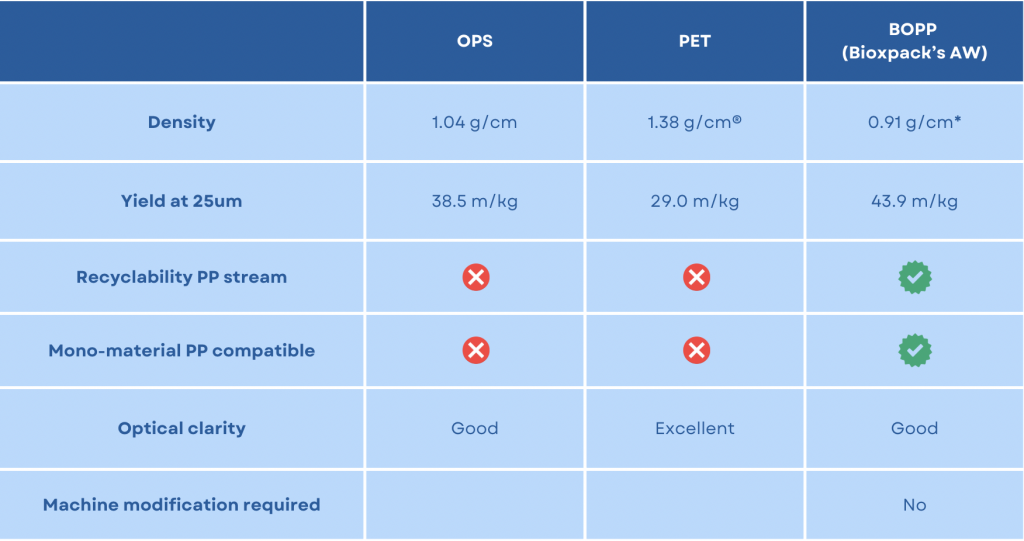
At 0.91 g/cm³ versus 1.04 g/cm³ for OPS, BOPP delivers around 12% more surface area per kilogram. At industrial volumes, this translates directly into lower material cost per envelope — an advantage that compounds significantly at scale.
Recyclability
Specialty BOPP window films are compatible with PP recycling streams. When integrated into a mono-material PP envelope structure with PP-compatible hot-melt adhesives, the complete envelope meets CEFLEX design-for-recycling guidelines — the most viable pathway to a recyclable envelope window under PPWR.
Machinability
The key word is specialty. A standard food packaging BOPP film is not suitable for envelope window converting. What is required is a high-rigidity bioriented copolymer film with COF calibrated for envelope equipment, controlled haze for postal readability, and low shrinkage at bonding temperatures. These requirements separate a specialty envelope window film from a commodity BOPP grade — and they are what make the transition from OPS possible on existing converting equipment — without capital investment in new machinery.
BOPP: The Recyclable Alternative That Runs on Existing Equipment
For envelope converters who buy film by the kilogram, density is not just a material property — it is a direct cost driver. At equivalent thickness, a lower-density film delivers more surface area per kilogram purchased, meaning more windows per roll and lower material cost per envelope.
At 25 microns, the yield difference between the three materials is significant :
- BOPP : 9 m²/kg
- OPS : 5 m²/kg
- PET : 0 m²/kg
For every 100 kg of film purchased, BOPP delivers 530 m² more than OPS and 1 490 m² more than PET — at the same thickness. At industrial converting volumes, this advantage compounds directly into margin.
Going Further: Biodegradable Window Films
For operators with specific biodegradability requirements beyond standard recyclability, a biodegradable bioriented copolymer window film is available — combining the converting performance of specialty BOPP with certified biodegradability, on the same equipment.
The transition from OPS to a recyclable BOPP window film is technically and commercially achievable for most envelope converters. The variable is qualification time — and with PPWR milestones approaching, that clock is running.